
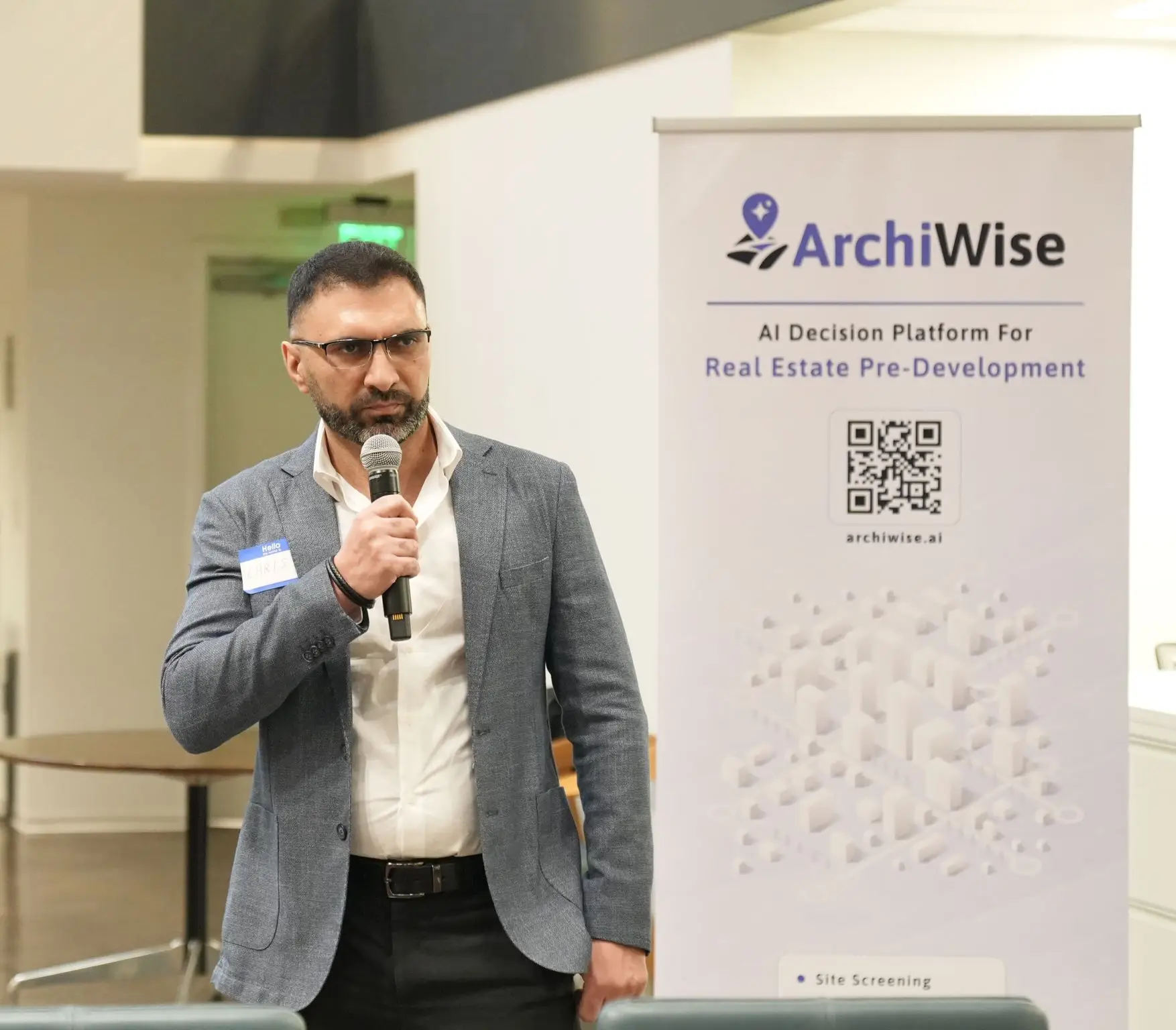

On February 19, 2026, ArchiWise AI introduced its pre-development decision intelligence platform during an industry panel discussion hosted at CBRE’s headquarters in Glendale, California.
Organized by ArchiWise AI in partnership with CBRE and ARMADS, the session – “From Code to Capital: Using AI to Navigate Zoning Change and Unlock Value” – brought together developers, planning professionals, and public sector representatives to examine how artificial intelligence is changing early-stage real estate decision-making.
We are grateful to everyone who attended and contributed to the discussion. The level of engagement and openness from industry professionals highlighted how urgent and relevant these challenges have become. It was especially valuable to hear real-world perspectives from practitioners actively navigating zoning, entitlement, and capital decisions in today’s regulatory environment.
The discussion came at a time when zoning reform, entitlement complexity, and capital discipline are increasing pressure on development teams to make faster, more defensible site selection decisions.

ArchiWise AI turns real estate site selection into a defensible, end-to-end decision workflow – in minutes, showing buildability, zoning regulations, and the highest-upside development paths (including hidden density) before you commit time or capital.
Why Pre-Development Decisions Matter Most
What became clear during the discussion is that the real estate industry is approaching a turning point. For decades, the earliest and most capital-sensitive decisions – where to build? what can be built? and whether a project will succeed? – have relied on fragmented research and professional intuition.
But as zoning systems evolve and financial margins tighten, that approach is becoming increasingly unsustainable. The ability to quickly translate regulatory complexity into clear, actionable development insight is no longer a convenience – it is becoming foundational infrastructure for modern real estate decision-making.
Real estate development risk is heavily concentrated in the earliest phase of a project – before design begins and before capital is fully committed.
Site selection, zoning interpretation, feasibility assumptions, and entitlement timelines determine whether a project is viable. Yet these decisions are still often made using fragmented tools, manual research, and incomplete information.
Developers must navigate zoning codes, overlays, infrastructure constraints, and approval processes that vary significantly between jurisdictions. Misinterpreting these factors can delay projects, reduce yield, or eliminate feasibility entirely.
As cities introduce new zoning frameworks and performance-based planning systems, the complexity of early-stage evaluation continues to increase.
Industry Perspectives on AI and Zoning Intelligence


The panel featured perspectives from across the development ecosystem, including:
- Ardashes “Ardy” Kassakhian, Councilmember, City of Glendale
- Edward Matevosian, Senior Vice President, CBRE
- Jenny Eng, First Vice President, CBRE
- Brandon Mann, Principal, FocalInvest
The discussion focused on how AI-driven analysis can help:
- Translate zoning regulations into actionable development constraints and opportunities
- Identify buildable potential earlier in the acquisition process
- Improve underwriting accuracy and reduce entitlement uncertainty
- Enable faster and more informed site selection decisions
Participants also emphasized the importance of transparency, verifiable regulatory sources, and maintaining professional oversight as AI tools become integrated into development workflows.
A sincere thank you to the CBRE team and ARMADS for hosting and supporting the discussion, and to everyone who joined us for an engaging conversation and networking afterward.
Introducing ArchiWise’s Decision Intelligence Platform
During the event, ArchiWise AI presented its platform, designed to help developers evaluate sites across the full pre-development decision chain.
Rather than relying solely on zoning labels or manual interpretation, ArchiWise analyzes parcels across multiple layers, including:
- Site screening and development potential
- Zoning constraints and development rights
- Physical buildable envelope
- Feasibility scenarios
- Approval and entitlement patterns
By consolidating these factors into a single workflow, ArchiWise enables development teams to identify viable sites earlier, validate assumptions, and reduce costly late-stage surprises.
A Shift Toward Decision Intelligence in Real Estate
The discussion at CBRE reflected a broader shift in the real estate industry – from fragmented zoning lookup and consultant-driven discovery toward structured, data-driven decision workflows.
As development timelines tighten and capital efficiency becomes increasingly important, the ability to evaluate buildability, risk, and upside early is becoming a critical competitive advantage.
Decision intelligence platforms like ArchiWise represent a new infrastructure layer for the pre-development phase – helping developers, investors, and planners move from assumption-based evaluation to measurable, parcel-level clarity.
Learn More
ArchiWise helps developers, investors, architects, and brokers move beyond zoning theory and into parcel-level reality – applying verified, city-specific regulations directly to the land being evaluated.
Whether screening sites, validating underwriting assumptions, or preparing for feasibility analysis, ArchiWise provides decision-ready intelligence before time and capital are committed.