
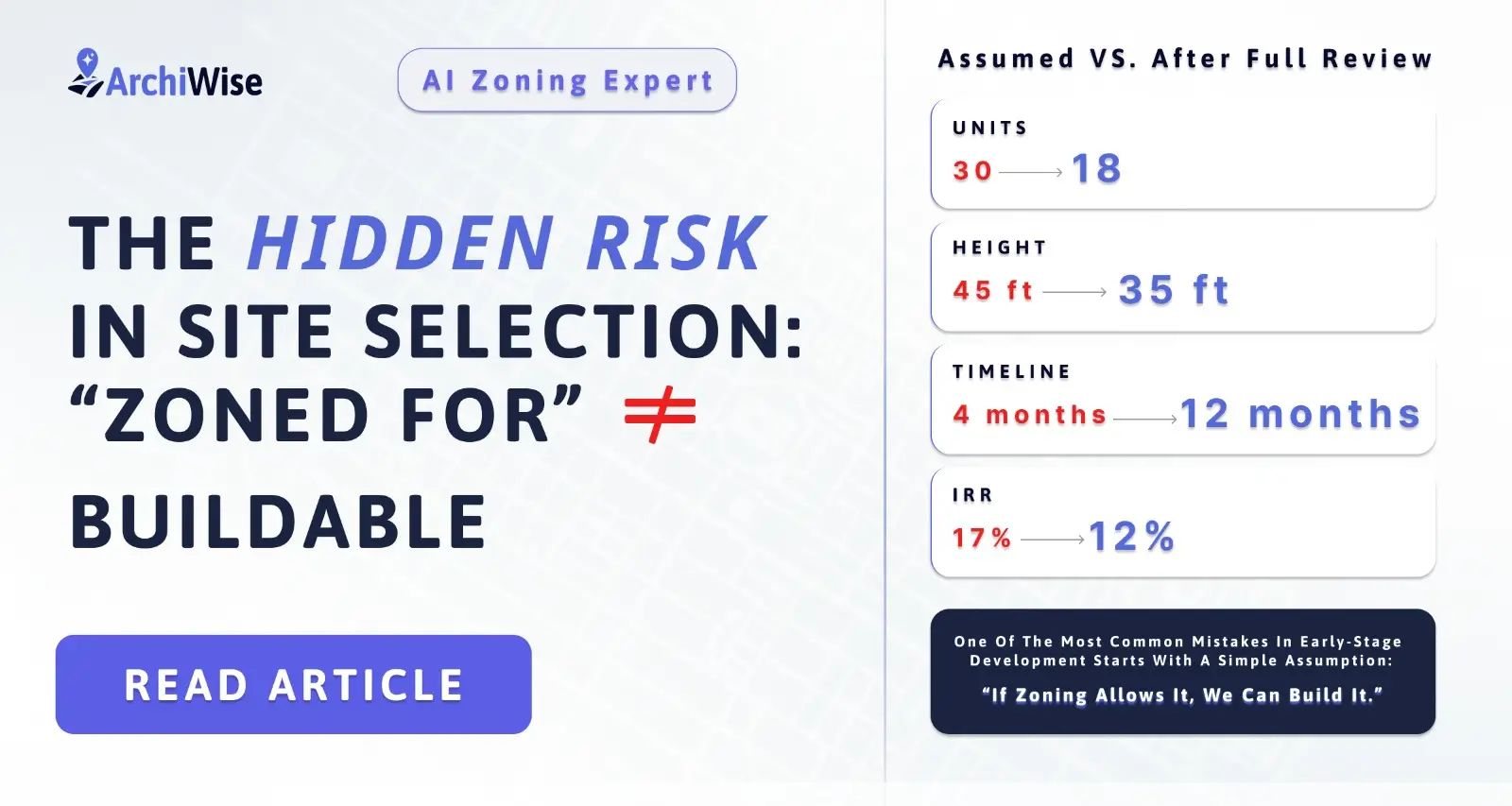

One of the most common mistakes in early-stage development starts with a simple assumption:
“If zoning allows it, we can build it.” 💬
On paper, a parcel may be zoned for multifamily. The density looks attractive. The numbers pencil at first glance.
But “zoning allowed” and “actually buildable” are two very different things. And the gap between them is where many deals quietly fail.
And confusing “allowed use” with “buildable project” is where costly mistakes begin.
Treating it as such has quietly distorted underwriting, inflated land values, and increased entitlement risk across major markets.
The Illusion of Safety
In competitive markets like Los Angeles, Glendale, Pasadena, and across Southern California, speed matters.
Deals move quickly. Capital moves quickly. Brokers summarize parcels in one sentence:
“R-3. 24 units.”
But base zoning is only the starting point. It is not a conclusion. It does not reflect:
- Overlay districts
- Specific plans
- Height step-downs
- Parking compression
- Infrastructure constraints
- Political approval dynamics
And yet underwriting often begins there. Zoning categories describe general intent, not project feasibility.
The Structural Gap Between “Allowed” and “Feasible”
The development industry tends to collapse complexity into a single number: units.
But unit count is the result of layered regulatory, physical, and political constraints.
A parcel zoned for 30 units may realistically support:
- 24 after envelope modeling
- 20 after parking
- 18 after height restrictions
- 18 with discretionary approval risk extending timeline by 9–12 months
At that point, the land price negotiated on a 30-unit assumption becomes misaligned with reality.
The mistake was not in design. It was in assumption.

Why This Gap Is Growing
Zoning systems are not getting simpler.
Cities are layering:
- Density bonuses
- Form-based standards
- Environmental overlays
- Fire and resilience regulations
- Infrastructure capacity controls
- Political and community review processes
At the same time:
- Interest rates are volatile
- Construction costs remain elevated
- Carry costs punish delay
- Investors demand tighter underwriting
The margin for regulatory misinterpretation has narrowed. Yet many deals still begin with a zoning summary.
Buildability Is a Multi-Dimensional Condition
A parcel is truly buildable only when four conditions align:
- Regulatory alignment – base zoning plus overlays and standards
- Physical feasibility – realistic envelope modeling
- Financial viability – yield supports land basis and capital structure
- Entitlement predictability – approval path is reasonably forecastable
Most early-stage evaluations only address the first dimension-and partially at that.
What Changes Next
As zoning reforms introduce hybrid systems and performance-based standards, regulatory complexity will increase, not decrease.
Simultaneously, AI-assisted analysis tools are entering the pre-development workflow-not to replace planners or architects, but to surface constraints earlier.
The shift underway is subtle but significant:
- From zoning interpretation to decision intelligence.
- From static code review to scenario-based feasibility testing.
- From reactive due diligence to proactive risk modeling.
The Cost of Getting It Wrong

A misread zoning envelope does not just reduce units.
It affects:
- Land basis
- Financing structure
- Design scope
- Approval timeline
- Carry exposure
- Investor confidence
The most expensive mistakes in development rarely begin in construction.
They begin in assumption.
How ArchiWise Helps Close the Gap Between “Allowed” and “Buildable”

The gap between zoning designation and true buildability exists because early-stage decisions rely on fragmented information-PDFs, GIS layers, consultant opinions, and assumptions made under time pressure.
ArchiWise is built specifically to address this pre-development blind spot by allowing developers to evaluate sites across the full decision chain before committing capital.
Instead of stopping at zoning labels, ArchiWise analyzes each parcel across five critical layers:
- Site Screening – identifying parcels with underutilized density or development potential
- AI Zoning Expert – translating zoning, overlays, and bonuses into clear, actionable limits and rights
- Area Intelligence – showing what can realistically fit on the site based on setbacks, height, and dimensional controls, identifying risks that don’t show up in zoning alone
- Feasibility Analysis – testing potential development outcomes to understand realistic yield and upside, compare multiple development scenarios to see which one delivers the maximum return
- Entitlement Viability – providing visibility into entitlement timelines and approval dynamics
This allows developers to move from a zoning classification to a decision-grade understanding of what can actually be built-before engaging consultants, negotiating land price, or committing capital.

Instead of discovering constraints weeks or months into due diligence, teams can identify risk, validate assumptions, and prioritize viable sites earlier in the process.
This fundamentally changes how deals are screened-from assumption-driven to intelligence-driven.
Final Thought
In modern real estate development, the most critical decisions are made before design begins, before consultants are hired, and before capital is committed. Yet this phase has historically relied on fragmented data, manual interpretation, and assumption.
As zoning systems grow more layered and entitlement timelines more unpredictable, competitive advantage will increasingly belong to those who can evaluate sites with clarity, speed, and precision-not just based on what zoning allows, but on what is truly buildable and defensible.
Platforms like ArchiWise reflect a broader shift already underway: from static zoning lookup to decision intelligence-where regulatory constraints, feasibility, and approval risk can be understood early enough to change outcomes.
Because in development, the difference between a successful project and an expensive mistake is often determined long before the first line is drawn.
Learn More
ArchiWise helps developers, investors, and planners move beyond zoning theory and into parcel-level reality-by applying verified, city-specific regulations directly to the land you’re analyzing.
Whether you’re screening sites, validating assumptions, or preparing for deeper feasibility work, ArchiWise gives you decision-ready insight before time and capital are committed.