
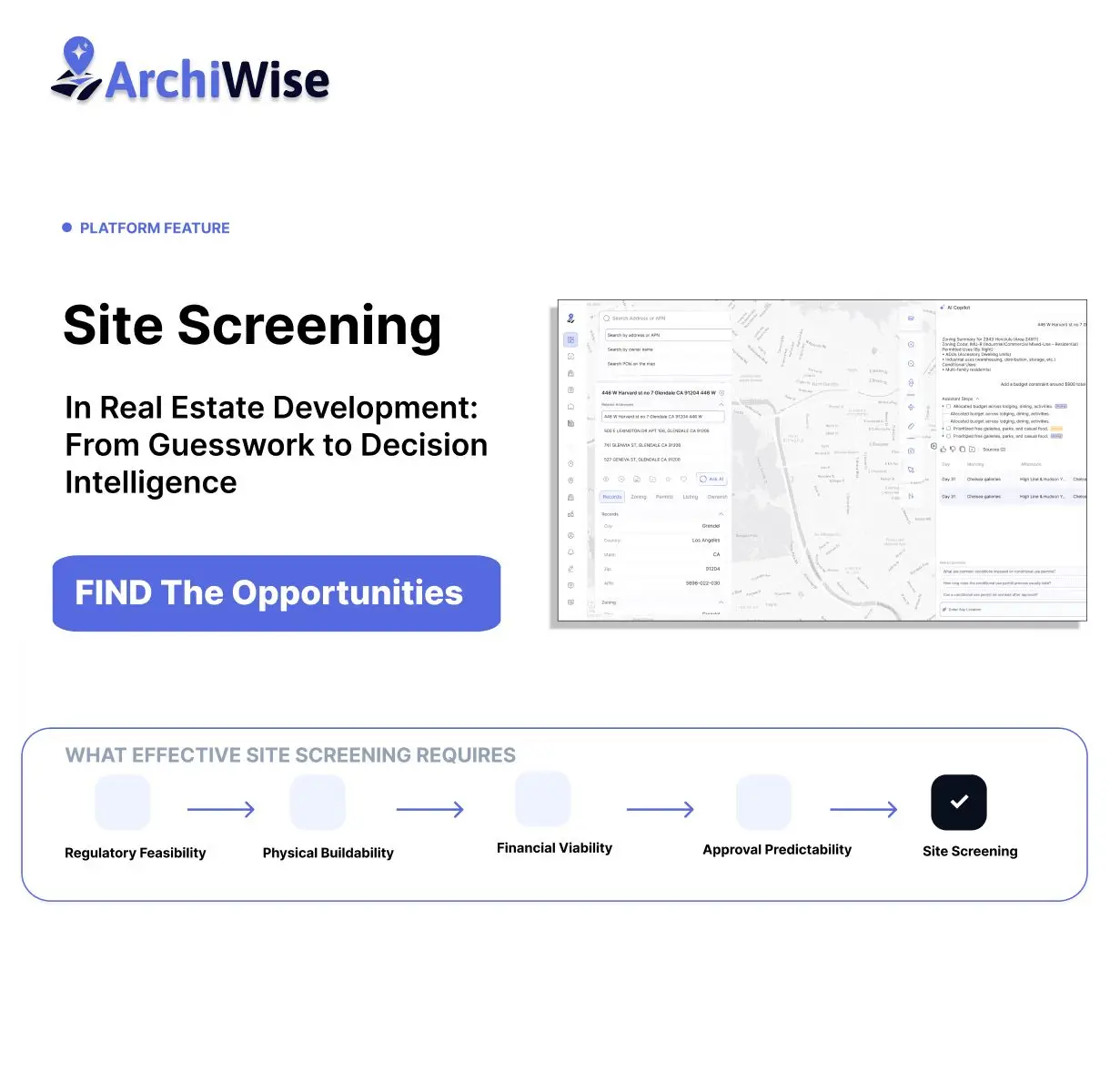

Every real estate development project begins with a decision that can quietly determine its success or failure:
Which site to pursue.
Before design begins.
Before capital is committed.
Before consultants are engaged.
A developer must answer a deceptively simple question:
Where should we build?
In theory, the answer should come from a structured evaluation of zoning, market demand, infrastructure, and financial feasibility.
In practice, however, site screening often relies on fragmented data, broker summaries, and assumptions made under time pressure.
The difference between a successful project and an expensive mistake is frequently determined long before design drawings exist.
Sometimes before the land is even under contract.
Why Site Screening Is So Difficult
At first glance, identifying a development site may seem straightforward.
Parcels are listed. Zoning categories are known. Density limits appear clear.
But real buildability depends on far more than a zoning label.
Effective site screening requires understanding several regulatory and physical layers simultaneously:
- Zoning regulations and overlays
- Height limits and setback constraints
- Density bonuses and development incentives
- Infrastructure capacity and environmental conditions
- Local approval patterns and entitlement timelines
Two parcels with identical zoning can produce completely different development outcomes depending on how these layers interact.
This complexity is why many developers still rely on a combination of manual research, consultant input, and professional intuition during early site screening.
The Hidden Risk in Early Site Screening
One of the most common pitfalls in site screening is evaluating parcels based only on base zoning.
A listing might say:
“R-3 zoning – 24 units.”
On paper, the opportunity appears straightforward.
But once deeper analysis begins, new constraints emerge:
- Height transitions reduce the buildable envelope
- Parking requirements reduce realistic unit yield
- Overlay districts trigger discretionary approvals
- Infrastructure limitations require costly upgrades
What began as a 24-unit opportunity can quickly become a 16-unit project with a completely different financial outcome.
By the time these constraints are discovered, land may already be under contract or underwriting assumptions may already be set.
The result is misaligned land pricing, compressed returns, or deals that fail during due diligence.
In competitive markets where acquisition timelines are short, discovering these factors too late can significantly impact project feasibility.
What Effective Site Screening Actually Requires
A reliable site screening process evaluates a parcel across several critical dimensions.
1. Regulatory Feasibility
Understanding what zoning actually permits requires more than reading the base designation.
Developers must account for overlays, bonuses, dimensional standards, and local interpretation of regulations.
2. Physical Buildability
Even when zoning allows a certain density, the physical site conditions – setbacks, height limits, lot configuration, and neighboring structures – determine what can realistically be constructed.
Zoning tells you what a city allows. Buildability tells you what a developer can actually construct.
3. Financial Viability
The combination of unit yield, construction cost, entitlement timeline, and financing structure determines whether a project supports the land basis.
4. Approval Predictability
Entitlement timelines vary dramatically across jurisdictions.
Two identical projects may experience approval timelines ranging from a few months to more than a year depending on local political and community dynamics.
Site screening becomes far more reliable when all four dimensions are evaluated together, rather than sequentially.
A New Approach to Site Screening
Traditionally, assembling this information required weeks of manual research across multiple sources:
- Municipal code documents
- GIS layers
- Planning consultations
- Feasibility modeling
Today, decision-intelligence platforms are beginning to change how developers approach site screening.
Instead of evaluating parcels sequentially through disconnected tools, platforms like ArchiWise analyze potential sites across the entire pre-development decision chain.
When screening sites, ArchiWise evaluates parcels across multiple layers:
- Site screening to identify parcels with underutilized density or development potential
- Zoning intelligence translating local regulations into clear development constraints
- Buildable envelope analysis showing realistic development capacity
- Feasibility insights helping teams understand potential yield scenarios
- Entitlement signals highlighting patterns in approval timelines and jurisdiction behavior
This allows development teams to move from zoning labels to decision-ready insight much earlier in the acquisition process.
Instead of asking only:
“What is this parcel zoned for?”
Developers can evaluate the far more important question:
“What can realistically be built here – and at what risk?”
Why Early Intelligence Changes the Deal
The value of early site screening intelligence is not just speed.
It is decision quality.
When developers understand buildability earlier, they can:
- Avoid pursuing sites with hidden regulatory constraints
- Identify parcels with overlooked density potential
- Align land pricing with realistic development capacity
- Structure underwriting assumptions with greater confidence
In competitive acquisition environments, this clarity allows developers to move faster and more decisively on viable opportunities.
The Future of Site Screening
Real estate development is entering a period of increasing regulatory complexity.
Cities are introducing hybrid zoning systems, performance-based standards, and layered environmental requirements. At the same time, investors are demanding tighter underwriting and faster project delivery.
These forces are pushing the industry toward a more structured approach to early-stage decision-making.
Site screening is evolving from a process based on fragmented research and professional intuition into one supported by integrated development intelligence.
Platforms like ArchiWise are part of this shift – helping development teams evaluate sites with greater clarity before time, capital, and design resources are committed.
Final Thought
In development, the most expensive mistakes rarely happen during construction.
They begin much earlier.
They begin when a site is selected based on an incomplete understanding of what can actually be built.
As markets grow more competitive and regulations more layered, the developers who succeed will not simply move fastest on listings.
They will be the ones who understand buildability first – before the competition, before design begins, and before capital is committed.
Learn More
ArchiWise helps developers, investors, architects, and brokers move beyond zoning theory and into parcel-level reality.
Whether you’re screening sites, validating assumptions, or preparing for deeper feasibility work, ArchiWise gives you decision-ready insight before time and capital are committed.